 By ando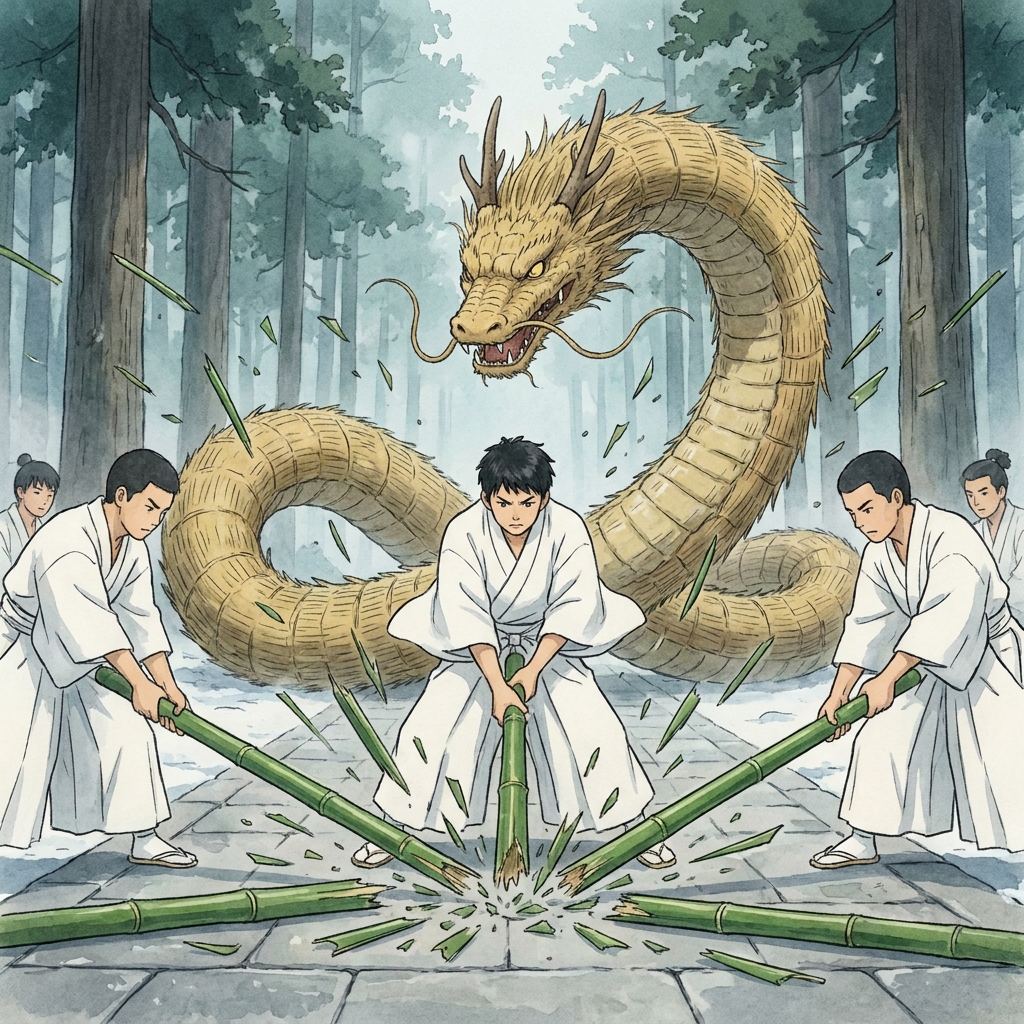
Sugouishibe Jinja, located in Daishoji, Kaga City, Ishikawa Prefecture. Locals affectionately call it “Shikiji Tenjin” or “Gongansan.” This jinja boasts the high rank of Kaga no Kuni Ninomiya (the second most important shrine of Kaga Province) and has a history of over 1400 years, holding many surprising and unique festivals as well as interesting hidden stories.
Basic Information
Location: Ru-Otsu 81, Shikiji, Daishoji, Kaga City, Ishikawa Prefecture
Enshrined Kami: Sugouishibe no kami
Note: This is a collective term for three kami: Hikohodemi no mikoto, Toyotamahime no mikoto, and Ugayafukiaezu no mikoto.
Founded: 585 AD (1st year of Emperor Yomei’s reign)
The Courageous and Unique “Takewari Matsuri (Gongan Shinji)”
An indispensable topic when talking about this jinja is the “Gongan Shinji,” commonly known as the “Takewari Matsuri,” held annually on February 10th.
The sight of young men dressed in white garments smashing some 400 to 500 green bamboo poles against the stone pavement of the shrine grounds, breaking them into smithereens, is truly breathtaking. This shinji (Shinto ritual) embodies a legend of vanquishing a “giant serpent” that once ravaged this land.
Finally, a massive 20-meter-long rope, representing the giant serpent, is dragged from the haiden (worship hall) and thrown into the nearby Daishoji River to pray for the warding off of epidemics.
[Backstory] Are the broken bamboo pieces the ultimate good luck charm?
Worshipers are free to take home fragments of the bamboo broken into smithereens during the ritual. Local beliefs include “If you make chopsticks from this bamboo, toothaches will be cured,” “If you place it at your entrance, it will ward off evil,” and “If you use it as the frame for a kite, the kite will fly high.” It is extremely popular as a good luck charm.
Root of a Surname? The Sacred Site for People with the “Saito” Name
This jinja is actually known as a place associated with the “Saito” (斎藤) surname, which is common throughout Japan.
There is a theory that during the Heian Period, Fujiwara no Nobumochi, who served as the Head of the Ise Saigu (an imperial princess serving at Ise Grand Shrine), invited and enshrined the kami of Sugouishibe Jinja as his clan’s tutelary kami. From this act, he is said to have adopted the name “Saito” (斎 from Saigu, 藤 from Fujiwara). For those tracing the roots of the Saito surname, this is an indispensable sacred site.
Never Look Back? The Mystery of “Okori Otoshi”
Sugouishibe Jinja has a strange custom that has been passed down since ancient times.
It was once believed that if someone suffering from “Okori” (epidemic or fever) removed their sandals under the torii at dawn, offered prayers, and then returned home by descending the “onna-zaka” (woman’s slope) without ever looking back, their illness would be cured. This taboo of “never looking back,” much like in ancient myths, still lives on in the jinja’s history.
Other Interesting Backstories and Legends
The Reason for Not Offering Sea Bream: In a myth where the main enshrined kami, Yamasachihiko (Hikohodemi no mikoto), lost Umisachihiko’s fishing hook, the hook was found stuck in a sea bream’s throat. Due to this myth, this jinja has a rare custom of not offering sea bream as shinsen (Shinto food offerings) since ancient times.
Kami’s Messengers are Snakes and Turtles: Within the shrine grounds, snakes and turtles are treasured as messengers of the kami. It is said that if you harm or eat them, your wishes will not be granted.
The Origin of Kyoto’s “Wara Tenjin”: Shikiji Jinja (Wara Tenjin) in Kyoto, famous for prayers for safe childbirth, is actually said to have been established by inviting a kami from this Sugouishibe Jinja.
Pilgrimage Information: Anime “Nihon Sangoku”
In recent years, the popular work “Nihon Sangoku,” which depicts Japan transformed into a fictional Sengoku period, has garnered attention from manga and anime fans.
The series features a character named “Sugou Tsuyoshi,” whose name is reminiscent of this jinja. Furthermore, various locations in Ishikawa Prefecture (Seii Kaga Province) serve as models for the story’s setting, leading to an increasing number of fans visiting the Kaga area’s important spots as part of their “sacred site pilgrimage” (anime pilgrimage).
With its deep history, the intensity of its festivals, and unexpected connections to surnames and anime, Sugouishibe Jinja is a mysterious power spot offering new discoveries with every visit. When you visit Kaga Onsenkyo, be sure to stop by.
Related Links / References
[1] The Unique Shinji of Kaga Region “Gongan Shinji” – Cultural Affairs Agency PR Magazine Bunkaru
[2] One moment, please…
[3] One moment, please…
[4] Sugouishibe Jinja Tenjin-ko | Haguro Jinja Chief Priest’s Blog
[5] Sugouishibe Jinja | Official Kaga Onsenkyo
[6] Gongan Shinji | Official Kaga Onsenkyo
[7] Sugouishibe Jinja – Wikipedia
[8] Sugouishibe Jinja: Access, Hours, Fees – Jalan.net
[9] Kaga Onsenkyo: The Gongan Shinji (Takewari Matsuri) of Sugouishibe Jinja Preserves 1300 Years of History – Kaga City Tourism Exchange Organization Press Release
[10] 501 Not Implemented
[11] Sugouishibe Jinja
[12] Sugouishibe Jinja | Spots | Official Ishikawa Prefecture Tourism/Travel Site “Hot Ishikawa Tabi Net”
[13] What are the benefits and goshuin of Sugouishibe Jinja? Introducing its mystical power and available goshuin | BEST Time In Ishikawa Prefecture
[14] 501 Not Implemented
[15] Gongan Shinji (Takewari Matsuri)
[16] Takewari Matsuri
[17] [Sacred Site Pilgrimage] TV Anime “Nihon Sangoku” Stamp Rally Now Underway | News List | Kanazawa Film Commission