 By ando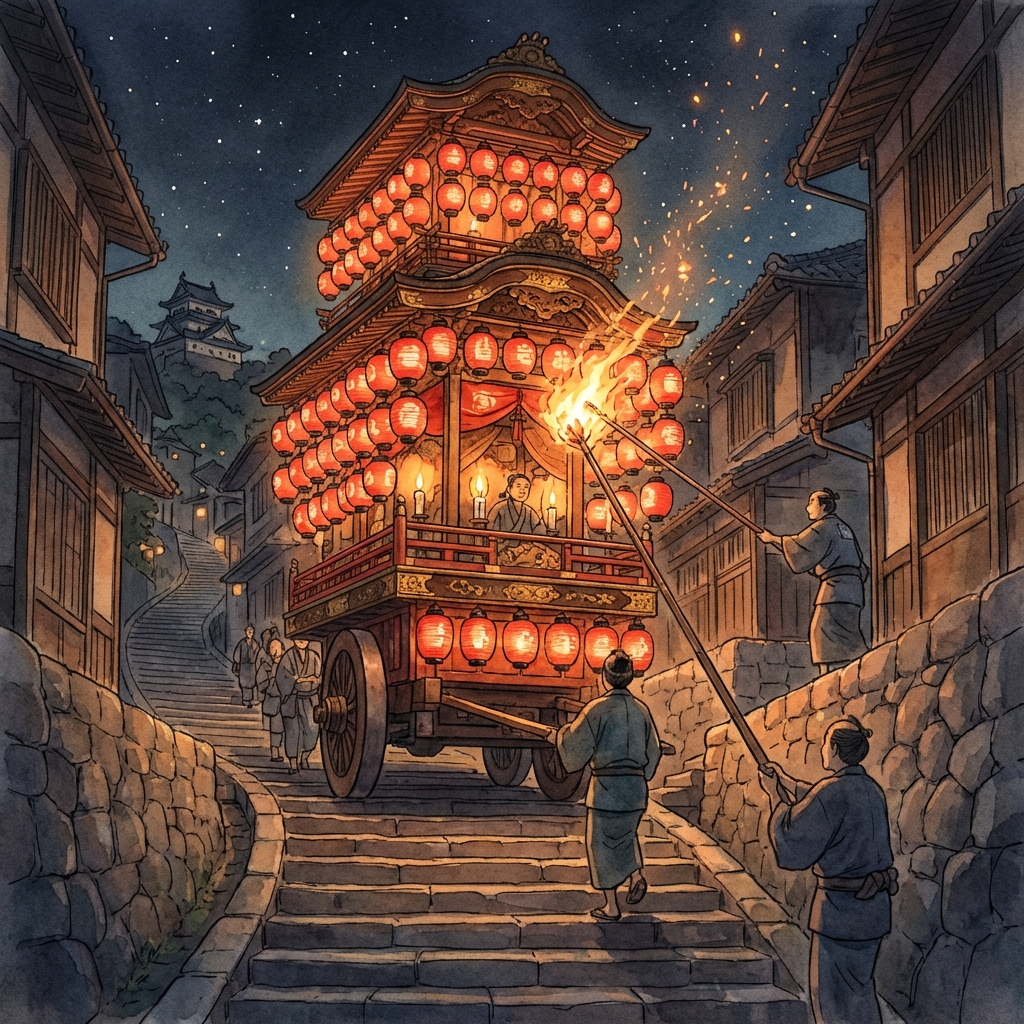
Basic Information
Name: Nihonmatsu Jinja. Location: 1-61 Honmachi, Nihonmatsu City, Fukushima Prefecture. Enshrined kami: Homudawake no Mikoto (also known as Hachiman-sama) and Izanami no Mikoto (also known as Kumano-sama). Annual Grand Festival: Nihonmatsu Lantern Festival (held annually on the first Saturday, Sunday, and Monday of October).
The Mystery of “Goryosha” Enshrining Two Kami, and the Thoughtful Gesture of the Feudal Lord
When you visit Nihonmatsu Jinja, you will notice that two kami are enshrined side-by-side in a single shrine building. This was once known as “Goryosha,” meaning “the two shrines.”
Behind this lies a deep intention of Niwa Mitsushige, the first feudal lord of the Nihonmatsu Domain. Upon his arrival in 1643, Lord Mitsushige moved Hachiman-gu and Kumano-gu, which were located within the castle grounds, to their current site and enshrined them together.
What is interesting is their arrangement. On the left side, facing the shrine, he enshrined Hachiman-sama, the guardian deity of the Niwa family. On the right, he enshrined Kumano-sama, the guardian deity of the common people. This arrangement is said to be an expression of the spirit of reverence for the kami and love for the people, symbolizing “the lord and the people uniting as one to support the nation.”
The Legend of the “Two Pines” That Gave the Place Its Name
While there are various theories about the origin of the place name “Nihonmatsu” itself, a legend related to the jinja also remains.
One theory suggests that in ancient times, there was a giant pine tree here with a single root but two trunks. Another tradition recounts that Ariwara no Narihira, a poet from the Heian period, admired two magnificent pine trees when he visited this area. As the “sochinju” (total guardian deity) of the region, the jinja bore this name and has continued to watch over the town’s history.
One of Japan’s Three Great Lantern Festivals: The Mystery of the “Goshinka” Scorching the Darkness
When it comes to Nihonmatsu Jinja, the “Nihonmatsu Lantern Festival” is undoubtedly its highlight. It is counted as one of Japan’s Three Great Lantern Festivals, alongside Akita’s Kanto Festival and Owari Tsushima’s festival.
The greatest spectacle of this festival is the lighting ceremony held on the first day’s “Yoimatsuri” (evening festival). Approximately 3,000 crimson lanterns are hoisted on seven taiko-dai (floats). There is a strict rule that the fire used to light all of these lanterns must be the “goshinka” (sacred fire) taken from the precincts of Nihonmatsu Jinja.
Using lighters or matches is forbidden. The sight of the sacred fire being passed from lantern to lantern is truly the moment when the soul of the kami is breathed into the entire town. The flickering flames of real candles dyeing the castle town red at night create a breathtakingly beautiful and fantastical scene.
Behind the Scenes: The Secret of the “Ohayashi” Born from a Hilly Town
Nihonmatsu is a castle town with many steep slopes. It is arduous work for the young people (wakaren) to pull around taiko-dai weighing several tons, but the “Nihonmatsu Festival Ohayashi” (a Prefecturally Designated Important Intangible Folk Cultural Property) plays a crucial role here.
In fact, specific musical pieces are played when ascending a hill, descending a hill, and turning a corner. This is not merely background music; it also functions as a “signal” to synchronize the breath of the pullers and boost their morale.
Sacred Site Pilgrimage Information: Historical Anime and the “Nihonmatsu Shonentai”
Nihonmatsu City, where Nihonmatsu Jinja is located, is also known as the setting for the tragic “Nihonmatsu Shonentai” (Nihonmatsu Youth Corps) of the Bakumatsu period.
‘Bakumatsu Rock’: This work, set in the Bakumatsu period, features characters and episodes based on the Nihonmatsu Shonentai, attracting the attention of history and anime fans. ‘Kurozuka KUROZUKA’: Based on Baku Yumemakura’s novel, which draws from the ‘Adachigahara no Onibaba Legend’ passed down in Nihonmatsu City, this anime adaptation brings fans to the city to explore the roots of the work.
Nihonmatsu Jinja is a place where the members of the Youth Corps might have prayed for victory before going into battle. The origins of “bushido” (the samurai spirit) and “love for one’s homeland” depicted in anime and historical works still breathe within the tranquil atmosphere of this jinja today.
Related Links and References
[1] ERROR: The request could not be satisfied
[2] Fukushima Sacred Site Pilgrimage | Notenki Pyonkichi-kun
[3] https://www.nihonmatsu-kanko.jp/wp-content/uploads/2016/07/cho-pamp02.pdf
[4] Fukushima Prefecture, home to numerous anime pilgrimage sites, is hot! | Másmás Fukushima
[5] Going Far Away | Yomiuri TV / Nippon TV Network
[6] 501 Not Implemented
[7] Nihonmatsu Jinja Shrine by Tenku Sennin’s Shrine and Temple Tour
[8] Origin of the Festival | Tourism | Official Nihonmatsu City Website
[9] Evocative Resting Place Details-16 Nihonmatsu Chochin Matsuri
[10] Nihonmatsu Jinja | Nihonmatsu City Tourism Association
[11] Nihonmatsu Lantern Festival | The “Era” Yae Was Born In | Yae’s Hometown, Fukushima Prefecture
[12] “Iwaki” X (formerly Twitter) search results – Yahoo! Real-time search
[13] “Taiwan Invasion” X (formerly Twitter) search results – Yahoo! Real-time search
[14] Nihonmatsu Chamber of Commerce and Industry Website [Strolling Nihonmatsu: Castle Town Exploration]