 By ando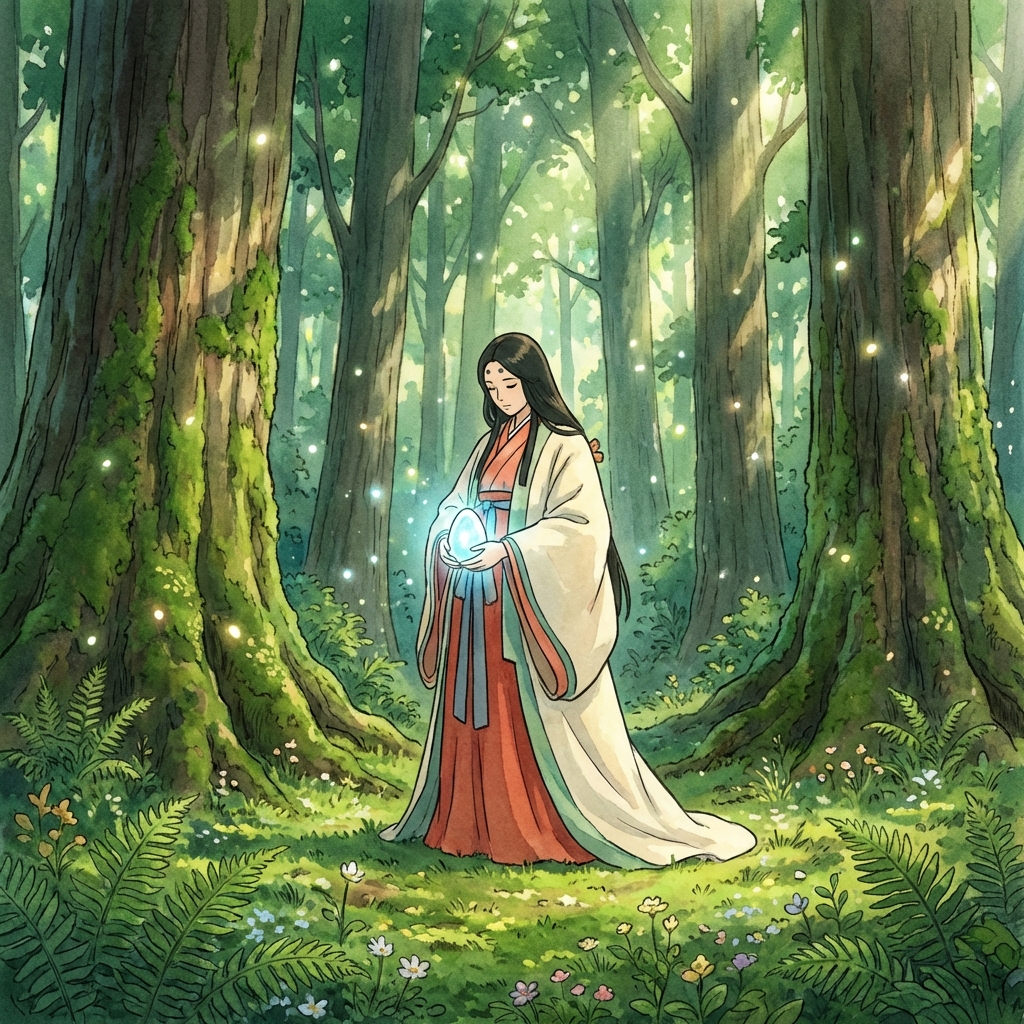
On Iki Island in Nagasaki Prefecture, an island surrounded by beautiful seas, stands an important jinja that connects to the very roots of Japanese faith. This is Tsukuyomi Jinja. While it may appear to be a small sanctuary quietly nestled in a forest, this spot is actually considered the “Sohonsha” (grand head shrine) for Tsukuyomi Jinja shrines located throughout Japan. It is even whispered to be the “birthplace of Shinto,” making it a power spot with an immense, hidden history.
Did Kyoto’s Tsukuyomi Jinja Begin Here? The Legend of the Bunrei (Divided Kami)
Essential to understanding the significance of this jinja is an episode from 487 CE. According to the Nihon Shoki (Chronicles of Japan), during the reign of Emperor Kenzo, the kami of the moon possessed a person and delivered an oracle (a divine message), saying, “Enshrine me in Kyoto, and good fortune will follow.”
In response, the Imperial Court summoned Oshimi no Sukune, an ancestor of Iki’s agatanushi (provincial governor), and arranged for a bunrei (divided kami) to be relocated from Iki’s Tsukuyomi Jinja to Kyoto. This is considered the origin of the Tsukuyomi Jinja located next to Kyoto’s Matsunoo Taisha. In other words, even Kyoto’s famous Tsukuyomi Jinja ultimately originated from this small forest on Iki Island.
The Mystery of the Legendary Sacred Treasure, the “Tsukinobe-ishi”
Within the shrine grounds, a legend remains about the “Tsukinobe-ishi,” known as a symbol of prayers for safe childbirth.
It is said that long ago, during her expedition to the Three Han kingdoms, Empress Jingu placed a stone on her waist to delay the birth of her unborn child, who would later become Emperor Ojin. One of these stones is said to have been offered to this Tsukuyomi Jinja.
While it is difficult to see the stone directly today, this legend ensures a constant stream of visitors praying for safe childbirth. Since the waxing and waning of the moon govern the tides and the biorhythms of life, the kami of the moon is believed to have a deep connection with safe childbirth.
Was It a “Yama no Kami” (Mountain Kami)? The Mystery of a Rewritten History
There’s an untold story that this jinja was actually enshrined as a “Yama no Kami” (mountain kami) until the Edo period.
In 1676, Tachibana Mitsuyoshi, a kokugakusha (scholar of Japanese classics) commissioned by the Hirado Domain, investigated the Shikinaisha shrines in Iki and identified this location as Tsukuyomi Jinja. Until then, there was no shaden (shrine building); it seems the dense forest itself, with its giant trees, was the object of worship.
However, there are dissenting opinions, with some theories suggesting that the original Tsukuyomi Jinja was in a different location (such as near the current Hakozaki Hachiman Jinja). Why was this particular location chosen? Or was it truly an ancient sacred area? As you step into the lush forest, you are enveloped in a serene atmosphere, as if it holds all the answers.
Pilgrimage: A Lunar Sanctuary Also Noted by Touhou Project Fans
This jinja is also quietly drawing attention in the world of subculture, including anime and games.
Especially among fans of the popular work “Touhou Project” (Touhou-zei), which features many moon-themed characters, visitors continuously come to this jinja as one of their “sacred sites” due to its connection with characters like Tsukuyomi no Mikoto and the Watatsuki Sisters (Watatsuki Toyohime and Watatsuki Yorihime).
While there are no official collaborations, the overwhelming status of this jinja as the “Sohonsha” (grand head shrine) dedicated to the kami of the moon seems to be the motivation for fans undertaking their “seichi junrei” (pilgrimage to a sacred site).
Basic Information
Location: 464 Kokubu Higashifure, Ashibe-cho, Iki City, Nagasaki Prefecture
Enshrined Kami: Tsukuyomi no Mikoto
Blessings: Safe childbirth, health, maritime safety, good harvest
Access: Approximately 10 minutes by car from Ashibe Port. The shaden (main shrine building) is located at the top of steep stone steps, past the torii (shrine gate) along the prefectural road.
Advice for Visitors
The shrine grounds are very quiet, with a mystical atmosphere where sunlight filters through the trees even during the day. The stone steps are quite steep, so we recommend wearing comfortable shoes for your visit. At the shamushō (shrine office), you can also obtain an Iki City original goshuincho (seal book) and an omamori (amulet) called “Mizu no Oto,” which recreates the sound of a suikinkutsu (water koto cave). These are popular souvenirs of your visit.
Iki’s Tsukuyomi Jinja has quietly yet powerfully etched its history, much like the light of the moon. Why not visit and experience the mystery that continues from the age of myths?
Related Links and References
[1] Honmyagu of Tsukuyomi Jinja throughout Japan – Iki Retreat Kairi Murakami by Onko Chishin (https://iki.by-onko-chishin.com/2963/)
[2] Tsukuyomi Jinja (Iki City, Nagasaki Prefecture) | Yaoyorozu no Kami Ukiyo-e Artist Daisuke Mochida (https://ameblo.jp/yaoyorozu-ukiyoe/entry-12866603515.html)
[3] About Works Featuring Tsushima and Sacred Sites | News | Tsushima Tourism Association (https://www.tsushima-net.org/news/tsushima_work)
[4] History – Tsukuyomi Jinja (https://tsukiyomijinja.com/yuisyo/)
[5] The Mystery of Iki, Tsukuyomi Jinja: An Ancient Shrine Whispered to be the Birthplace of Shinto – (https://jinjanews.com/ja/%E5%A3%B1%E5%B2%90%E3%81%AE%E7%A5%9E%E7%A7%98%E3%80%81%E6%9C%88%E8%AE%80%E7%A5%9E%E7%A4%BE%EF%BC%9A%E7%A5%9E%E9%81%93%E7%99%BA%E7%A5%A5%E3%81%AE%E5%9C%B0%E3%81%A8%E5%9B%81%E3%81%8B%E3%82%8C%E3%82%8B/)
[6] Iki no Tsukuyomi Jinja (http://www.ikishi.sakura.ne.jp/ikinotukiyomizinzya.html)
[7] Just a moment… (https://w.atwiki.jp/th_seiti/pages/64.html)
[8] Tsukuyomi Jinja | The Grand Head Shrine of Tsukuyomi Jinja Nationwide, Filled with a Divine Atmosphere / Iki | Tabirai (https://www.tabirai.net/sightseeing/column/0008997.aspx)
[9] Tsukuyomi Jinja | Spots & Experiences | Iki Tourism Navi (Official) (https://www.ikikankou.com/spot/10100)
[10] Iki Tsukuyomi Jinja (Tsukuyomi Jinja, Tsukuyomi, Sohonsha) | Mutsu Satoshi’s Blog (mutsu-satoshi.com) (http://mutsu-satoshi.com/2009/08/12/%E5%A3%B1%E5%B2%90%E3%83%BB%E6%9C%88%E8%AE%80%E7%A5%9E%E7%A4%BE/)