
 By ando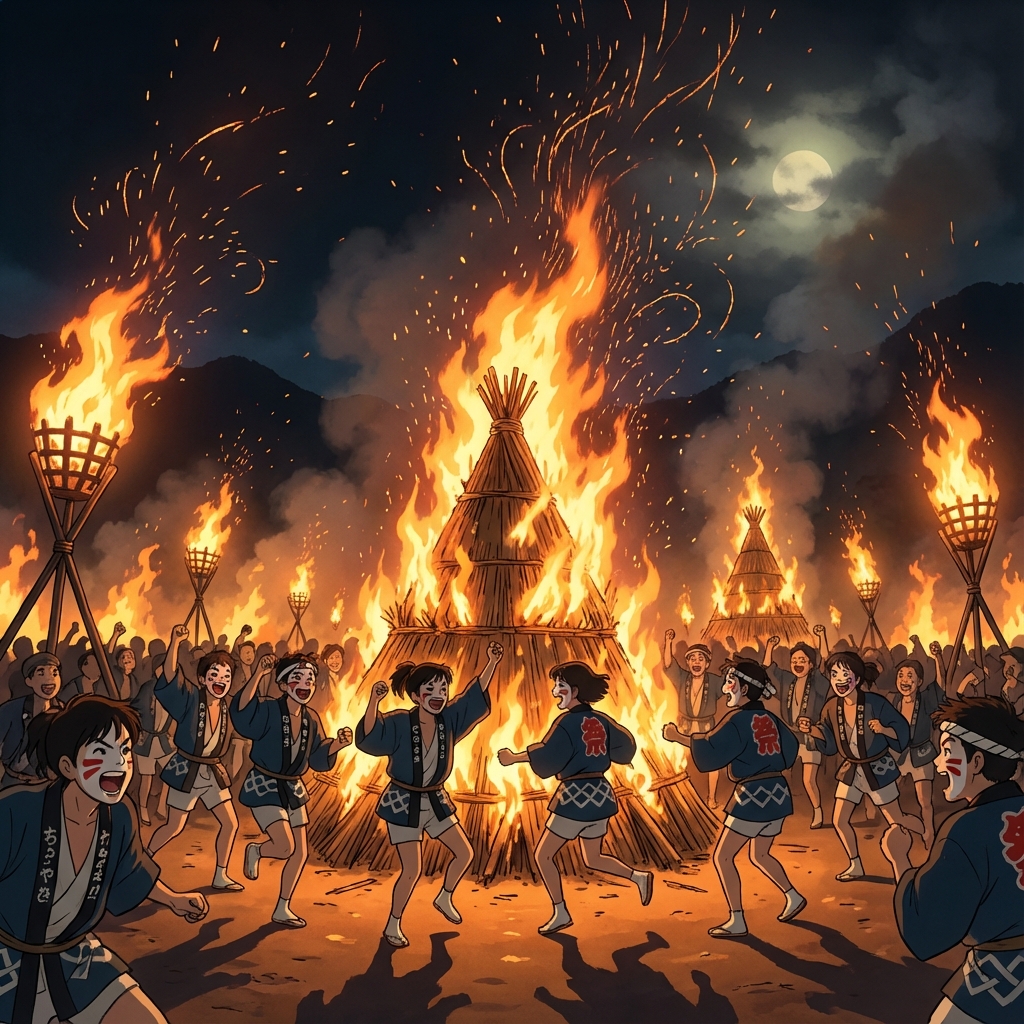
Himure Hachimangu, located in Omihachiman City, Shiga Prefecture, is an ancient shrine steeped in history and culture. It has long watched over the Omi region, with its name even becoming the origin of “Omihachiman” as a city name. It garnered deep faith from Omi merchants, who revered it as a kami for business prosperity and warding off misfortune. This article delves into the profound history of Himure Hachimangu and the allure of its two grand fire festivals that herald the arrival of spring in the Lake Country.
Basic Information on Himure Hachimangu
Himure Hachimangu is situated in Miyaunai-cho, Omihachiman City, Shiga Prefecture, boasting expansive sacred grounds. The three enshrined kami are Honda wake no Mikoto, Okinaga Tarashihime no Mikoto, and Himegami. The shrine precincts are also part of the “Omihachiman City Hachiman Traditional Buildings Preservation District,” a nationally designated Important Preservation District for Groups of Traditional Buildings, ensuring the preservation of its historical landscape.
A History Spanning a Thousand Years
The founding of Himure Hachimangu dates back approximately 1,900 years to the first year of Emperor Seimu’s reign (131 CE). It is said to have begun when Takeuchi Sukune enshrined Oshima Okami, the local guardian kami of the area. Later, in the 6th year of Emperor Ojin’s reign (275 CE), when Emperor Ojin visited Omi, a miraculous event occurred: he saw two suns (nichirin) at the site of his temporary resting place. The shrine was subsequently named “Higami no Yashiro Hachimangu.”
Furthermore, a legend states that in the 5th year of Empress Jito’s reign (691 CE), Fujiwara Fuhito visited the shrine and, inspired by his waka poem “Is this Hachiman, born of a kami descended from heaven? White clouds stream over the Himure forest,” the shrine’s name was changed to “Himure no Yashiro.”
During the medieval period, “Kami no Yashiro” (Upper Shrine) was established on Mt. Hachiman under an imperial decree from Emperor Ichijo, inviting the divine spirit of Usa Hachimangu. Later, “Shimo no Yashiro” (Lower Shrine) was built at the foot of the mountain as a remote worship hall. In Tensho 13 (1585), when Toyotomi Hidetsugu constructed Hachiman-yama Castle, Kami no Yashiro was merged into Shimo no Yashiro, forming the single shrine we see today. It is also said that Tokugawa Ieyasu prayed for lasting military fortune here after the Battle of Sekigahara, indicating the deep reverence the shrine received from powerful figures of the time.
Highlights and Hidden Stories
Himure Hachimangu offers numerous points of interest that tell tales of its history.
Of particular note is the “Annan Tokaisen Ema” (Votive Picture of a Ship Sailing to Annan), designated as a National Important Cultural Property. This is an ema (votive horse tablet) dedicated by Nishimura Taroemon, an Omi merchant who was active in trade with Annan (present-day Vietnam) during the Edo period. It holds a hidden anecdote evoking the romance and sorrow of Omi merchants: Taroemon, unable to return to Japan due to the national isolation policy, entrusted his likeness to this ema in his hometown shrine.
Furthermore, the Romon gate within the shrine precincts features monkey sculptures on its four corners, said to be the work of Hidari Jingoro. Passing through this gate is believed to be auspicious, as it signifies that “calamities leave” (saru) and “misfortune leaves” (saru), playing on the Japanese word for monkey, “saru,” which also means “to leave.”
The Byobu-iwa (Folding Screen Rock) towering behind the main hall and the serene Kagami-ike (Mirror Pond) are also sacred places that convey the form of ancient faith to the present day. Moreover, there is a mystery surrounding the alignment of Shirahige Jinja on the western shore of Lake Biwa, Okitsushima Jinja on Okishima island, and Himure Hachimangu, all lying in a straight line. One theory suggests that this alignment might imitate Munakata Taisha in Fukuoka Prefecture, which has long been revered as a kami for safe voyages.
Two Grand Fire Festivals Adorning the Lake Country
Himure Hachimangu is nationally famous for two magnificent fire festivals that represent Shiga Prefecture. These are also designated as National Selected Intangible Folk Cultural Properties.
Sagicho Festival
The Sagicho Festival, held annually on the Saturday and Sunday closest to March 14th and 15th, is renowned as a “Spectacular Festival of the Realm” and is known for announcing the arrival of spring in the Lake Country.
The origin of this festival lies in Chinese New Year customs, and in Japan, it spread as a festival praying for bountiful harvests and national peace. In Omihachiman, it is said to have been started by merchants who moved to the castle town when Toyotomi Hidetsugu built Hachiman-yama Castle.
The main stars of the festival are floats called “Dashi,” which are approximately 3-meter-high conical structures made of straw and cedar. Adorning the top are green bamboo, red paper, and decorations (dashi) related to the zodiac animal of the year. A unique characteristic of these “dashi” decorations is that they are made from food items such as seafood and grains.
On the day of the festival, young people, dressed in matching hanten coats and wearing makeup, boldly parade through the town carrying the Dashi, shouting “Choyare!” Some young men even dress in women’s clothing to carry the Dashi, which is one reason it’s called a spectacular festival. On the second day, a “kenka” (clash) between Dashi floats unfolds, and in the evening, the Dashi are successively set alight within the shrine precincts, culminating in a magnificent climax as flames scorch the night sky.
Records also show that Oda Nobunaga grandly held Sagicho in Azuchi castle town, even donning elaborate costumes and dancing among the townspeople. This splendor and fervor have thus been passed down from the Sengoku period.
Hachiman Festival
The Hachiman Festival, held annually on April 14th and 15th, is Himure Hachimangu’s regular festival, boasting a tradition of over a thousand years.
The origin of this festival is rooted in a legend involving Emperor Ojin. It is said that when Emperor Ojin crossed Lake Biwa to visit the birthplace of his mother, Empress Jingu, and landed at Minamitsuda, there were seven households along the lakeside that lit torches made of reeds to guide him to Hachiman. This is considered the prototype of the Hachiman Festival, a traditional festival that has been passed down for over 1,700 years since 275 CE.
On the night of April 14th, during the Yoimiya-sai (Torches Festival), nearly 200 torches of various sizes, including large ones exceeding 10 meters in height, are lit, transforming the shrine precincts into a sea of fire.
On the following day, April 15th, during the Hon-sai (Drum Festival), young men from the twelve old villages proudly carry large drums on their shoulders, entering the shrine with cries of “Dokkoishaanse!” In front of the worship hall, “Shushi” (Reverence) is performed, where the massive drums, weighing hundreds of kan (a traditional unit of weight), are lifted high and struck powerfully three times as an offering. The spectacle is truly breathtaking.
In Conclusion
From its founding to the present day, Himure Hachimangu has remained a central pillar of Omi’s history and the faith of its people. Its ancient legends, cultural assets that convey the spirit of Omi merchants, and above all, its two grand fire festivals that captivate onlookers, are sure to leave visitors with unforgettable impressions. When you visit Omihachiman, be sure to stop by Himure Hachimangu and experience its profound charm for yourself.
Related Links and References
Logging into joygamelogin was pretty straightforward. Nice and simple. No problems there! See for yourself: joygamelogin