
 By ando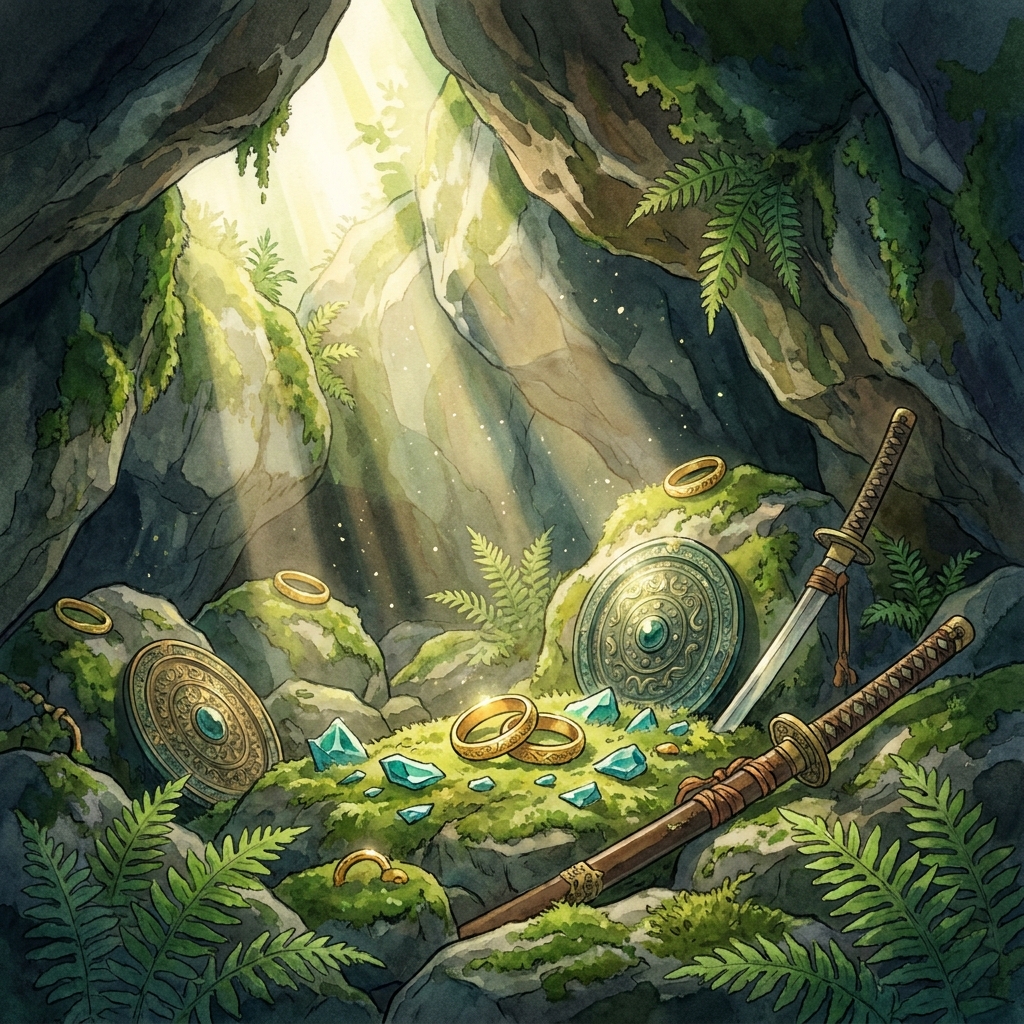
Basic Information
Name: Munakata Taisha (Munakata Grand Shrine)
Location: 2331 Tajima, Munakata City, Fukuoka Prefecture (Hetsugu Shrine)
Enshrined kami: Munakata Sanjojin (Three Goddesses of Munakata: Tagorihime-no-kami, Tagitsuhime-no-kami, Ichikishimahime-no-kami)
Structure: A collective term for the three shrines: Okitsugu on Okinoshima island, Nakatsugu on Oshima island, and Hetsugu on the main island of Kyushu.
World Heritage Site: Registered in 2017 as “Sacred Island of Okinoshima and Associated Sites in the Munakata Region.”
Oiwazusama and the Forbidden Island of Okinoshima
The most mysterious aspect of Munakata Taisha is Okitsugu, located on Okinoshima, a solitary island in the open sea about 60 km from the mainland. The entire island is considered a shintai (object of worship), and it has been protected by strict taboos since ancient times.
Women are forbidden: Landing by women has been prohibited since ancient times.
Misogi in the nude: Even men must remove all clothing and perform misogi (a ritual purification by washing in the sea) before landing on the island.
Oiwazusama: A rule that prohibits anyone from speaking about anything they see or hear on the island. Because of this, the details of the island have long remained shrouded in mystery.
No taking anything: It is forbidden to take anything from the island, not even a single fallen stone or leaf.
The “Shosoin of the Sea”: The Astonishing Fact of 80,000 National Treasures
On Okinoshima, large-scale national rituals were performed from the 4th to the 9th century. During surveys in the Showa era, a vast number of votive offerings, including gold rings, fragments of cut glass, mirrors, and weapons, were discovered in rock shelters. What is astonishing is that all approximately 80,000 excavated items have been designated National Treasures. Due to the immense quality and quantity of these items, Okinoshima is known as the “Shosoin of the Sea.” Some of these treasures can be viewed at the Shinpokan (Sacred Treasure Museum) located at Hetsugu.
The Mystery of the “Path of the Kami” Aligned in a Straight Line
If you connect the three shrines of Munakata Taisha (Hetsugu, Nakatsugu, and Okitsugu) on a map, they align perfectly in a straight line. Extending this line further to the northwest, it connects to the Korean Peninsula and ancient civilization sites. This is believed to be more than just a coincidence, suggesting that ancient people used these three shrines as important navigational guides for their interactions with the continent.
Takamiya Saijo: A Sacred Site Without a Shrine Building
Deep within the precincts of Hetsugu, nestled in a tranquil forest, lies Takamiya Saijo. This site is said to be where the Munakata Sanjojin descended, yet astonishingly, there is no shrine building (shaden). It is a very rare place in Japan that preserves the ancient form of ritual worship, with only cut stones arranged. Important Shinto rituals are still performed here today. Precisely because there is no building, it is a power spot where one can truly feel the energy of the primitive belief that kami dwell in nature itself.
Anime Pilgrimage Information
Munakata Taisha is also known as a sacred site for fans of the nationally popular anime, “Detective Conan.”
In Episode 931, “Kitakyushu Mystery Tour (Kokura Arc),” the heroine Ran Mouri visits Munakata Taisha alone. The torii gate and main hall of Hetsugu are faithfully depicted in the anime, and fans can be seen taking photos from the same angles.
Additionally, as part of The Nippon Foundation’s “Umi no Minwa no Machi Project” (Sea Folktale Town Project), a short animated film titled “Munakata Sanjojin and Okinoshima” has been produced, based on the legends of the Munakata Sanjojin and Okinoshima, clearly conveying local myths.
Related Links / References
[1] https://zipangu-tourism.com/posts/History0505
[2] https://www.mokuzaihozon.org/column/post_47/
[3] https://www.gov-online.go.jp/eng/publicity/book/hlj/html/201804/20180408jp.html
[4] https://www.city.munakata.lg.jp/kanko/kiji0032490/index.html
[5] https://uminominwa.jp/animation/88/
[6] https://japanmystery.com/fukuoka/munakata.html
[7] https://www.city.munakata.lg.jp/machihito/kiji0037224/index.html
[8] https://kurumenavi.com/report/111/
[9] https://pentagon67.com/archives/7704
[10] https://miare-art.com/shinpokan-2024/
[11] https://ameblo.jp/motoki070310/entry-12814376951.html
[12] https://www.munakata.link/3269/
[13] https://www.e-theoria.com/museum/038_02.html
[14] https://www.crossroadfukuoka.jp/feature/cultural
[15] https://www.okinoshima-heritage.jp/know/
[16] https://ontrip.jal.co.jp/kyushu/17312440
[17] https://www.pref.fukuoka.lg.jp/somu/graph-f/2017autumn/plan/index.html
[18] https://note.com/happy_oxalis9392/n/n96f00e9a1576
[19] https://jinjafan.jp/4002633/spots/1772/
[20] https://www.nta.co.jp/media/tripa/articles/sw4Xm
[21] https://www.okinoshima-heritage.jp/visit/sinpoukan.html
[22] https://muto-web.com/article/4898/
[23] https://m.youtube.com/watch?v=9fO5YL5WgTg